
 What's on
 Things to Do
 Plan your Visit
 Media Rules and Filming
𝐄𝐍𝐄𝐑𝐆𝐘 𝐒𝐄𝐂𝐓𝐎𝐑 𝐒𝐄𝐓 𝐅𝐎𝐑 𝐌𝐀𝐉𝐎𝐑 𝐑𝐄𝐅𝐎𝐑𝐌𝐒 𝐀𝐒 𝐍𝐀𝐓𝐈𝐎𝐍𝐀𝐋 𝐀𝐒𝐒𝐄𝐌𝐁𝐋𝐘 𝐀𝐃𝐎𝐏𝐓𝐒 𝐍𝐀𝐓𝐈𝐎𝐍𝐀𝐋 𝐄𝐍𝐄𝐑𝐆𝐘 𝐏𝐎𝐋𝐈𝐂𝐘


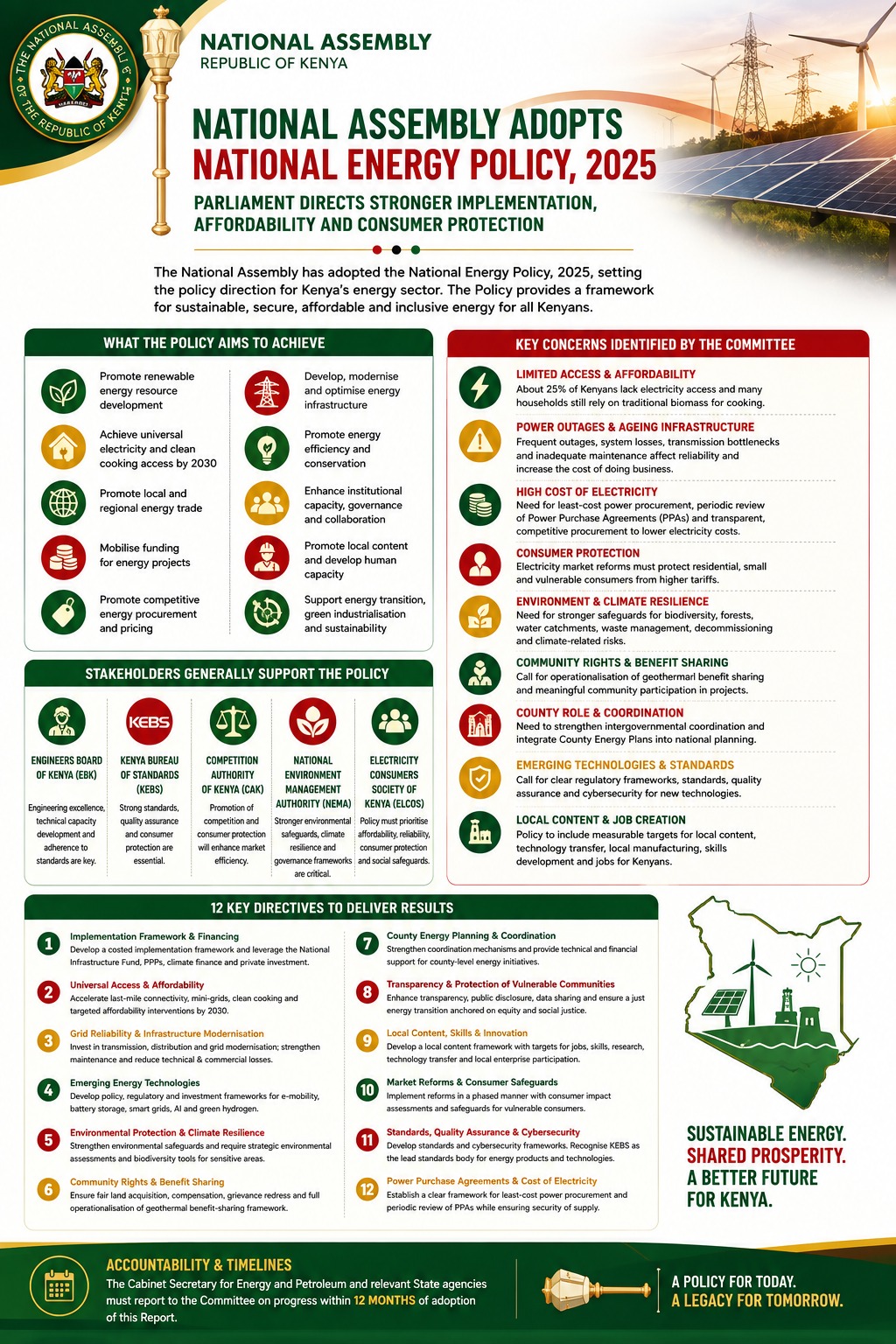
The National Assembly has adopted Sessional Paper No. 5 of 2026 on the National Energy Policy, 2025, providing a framework to guide the development of Kenya’s energy sector and strengthen its contribution to the country’s economic, environmental and social development.
The Policy seeks to promote renewable energy development, achieve universal electricity and clean cooking access by 2030, enhance energy efficiency, modernise energy infrastructure, promote competitive energy pricing and procurement, strengthen local content and support Kenya’s transition to a low-carbon and climate-resilient economy.
In moving the Motion, Energy Committee Chairperson Hon. David Gikaria described energy as a critical foundation for Kenya’s economic transformation and sustainable development.
“Energy, as we understand, is at the core of the economic transformation of any country. Access to energy serves as a driver towards a sustainable, inclusive and resilient future,” said Hon. Gikaria.
He noted that access to energy alone was not sufficient, emphasising the importance of reliability, affordability, competitiveness and environmental sustainability.
“We recognise that reliable, competitive, affordable and clean energy, as well as access to that energy by every Kenyan, is essential to realising our national development aspirations,” he added.
The Policy sets out strategic interventions across the energy sector, including electricity generation, transmission and distribution, renewable energy, clean cooking, energy efficiency, emerging technologies and climate change mitigation.
It also seeks to strengthen energy governance and institutional coordination, while promoting investment, local manufacturing, technology transfer, skills development and greater participation of Kenyan enterprises and professionals in the energy sector.
Supporting the Policy, Kilifi North MP Hon. Owen Baya noted that significant gaps in access to modern energy services remain, particularly among households that continue to rely on traditional sources of energy for cooking.
“This Policy addresses these gaps, propelling Kenya towards modern technological advancements and enabling the country to navigate global energy transitions,” said Hon. Baya.
The Policy further provides for the development of emerging energy technologies, including electric mobility, battery energy storage systems, smart grids, artificial intelligence and green hydrogen, with a view to positioning Kenya to take advantage of opportunities arising from the global energy transition.
On environmental sustainability, the Policy seeks to strengthen climate resilience and promote responsible development of energy resources, while addressing the protection of forests, water catchments, biodiversity and communities affected by energy projects.
The Policy also places emphasis on affordability and consumer protection, with measures aimed at promoting competitive electricity procurement, improving efficiency and ensuring that energy market reforms benefit consumers.
Following its adoption, the Cabinet Secretary for Energy and Petroleum, together with relevant State agencies, is required to implement the Policy and report on progress to the National Assembly within 12 months.