
 What's on
 Things to Do
 Plan your Visit
 Media Rules and Filming
𝐈𝐍𝐕𝐈𝐒𝐈𝐁𝐋𝐄 𝐁𝐔𝐓 𝐍𝐎𝐓 𝐅𝐎𝐑𝐆𝐎𝐓𝐓𝐄𝐍: 𝐒𝐄𝐍𝐀𝐓𝐎𝐑𝐒 𝐂𝐇𝐀𝐋𝐋𝐄𝐍𝐆𝐄 𝐆𝐎𝐕𝐄𝐑𝐍𝐌𝐄𝐍𝐓 𝐎𝐍 𝐈𝐍𝐂𝐋𝐔𝐒𝐈𝐎𝐍 𝐎𝐅 𝐏𝐄𝐑𝐒𝐎𝐍𝐒 𝐖𝐈𝐓𝐇 𝐈𝐍𝐕𝐈𝐒𝐈𝐁𝐋𝐄 𝐃𝐈𝐒𝐀𝐁𝐈𝐋𝐈𝐓𝐈𝐄𝐒







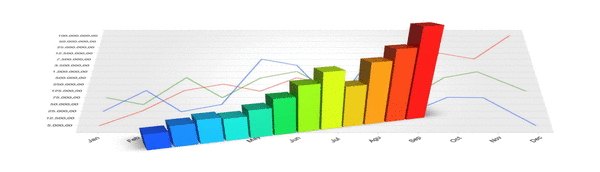
A fiery Senate session convened by the Standing Committee on Labour and Social Welfare laid bare the cracks in Kenya’s social protection fabric as Senators, stakeholders, and top government officials clashed over the country’s commitment to recognising and supporting persons living with invisible disabilities.
Led by Vice Chairperson Senator Crystal Asige, the committee invited Health Cabinet Secretary Hon. Aden Duale, Principal Secretary for Social Protection Mr. Joseph Motari, and representatives from the Council of Governors (COG) in response to a petition by Beatrice Likwop — a Kenyan living with invisible disabilities.
The petitioner’s heartfelt testimony painted a stark picture of systemic neglect and policy gaps. “Invisible disabilities are not only invisible in the body, they are invisible in the policy, invisible in the budget, invisible in the planning,” Beatrice said, her voice breaking. “We are tired of being statistics on paper, yet nothing reaches us on the ground.”
In his defense, CS Duale passionately outlined existing frameworks such as: The Disability Medical Assessment and Categorization Guidelines (2022) which include invisible disabilities like epilepsy, fibromyalgia, and mental health conditions; The rollout of the Social Health Authority (SHA) and associated funds the Emergency, Chronic, and Critical Illness Fund, the Social Health Insurance Fund, and the Primary Health Care Fund.
Ongoing training of healthcare providers on managing invisible conditions and community health promotion programmes. “The patient is now the boss,” said Duale. “We are building a system where every Kenyan, visible or invisible, is treated with dignity.”
However, Senator Miraj Abdulrahman (Nominated) raised questions. “What are the timelines and monitoring mechanisms for these policies? What are the ministry’s strategies to make specialist care affordable for those who cannot afford private facilities?”
Cabinet Secretary Aden Duale acknowledged the importance of structured timelines and strategies, affirming that: “We have monitoring and evaluation mechanisms. Our timelines are embedded within the health policy frameworks and guided by our digitisation efforts. We are continuously training our healthcare workers through in-service training to build their capacity to recognise and manage invisible conditions,” CS Duale said.
For the petitioner and her caregiver, the meeting was a moment of truth. Beatrice recounted how her SHIF registration had not guaranteed access to essential medication.
“You read from your papers, but I live it. You say essential drugs are provided. But I go to the hospital and I’m told they’re out of stock. I’m jobless, yet I must pay quarterly to a fund that doesn’t support me in return,” she said.
Alice Bundia, caregiver to an autistic young adult, added that children with invisible disabilities often end up in police custody due to a lack of identification.
“They’re non-speaking and locked out of homes. We need visible identifiers like sunflower bracelets for such children,” she pleaded.
The PS for Social Protection, Mr. Joseph Motari, responded that while such identifiers had been discussed, concerns around stigmatisation had slowed their rollout.
Across the session, a consensus emerged around critical areas needing immediate action: Institutionalized training for health workers, teachers, and law enforcers on handling invisible disabilities; Amendments to current legislation and policy frameworks to explicitly address invisible disabilities: Home-to-home disability surveys to generate accurate data and inform funding; Equitable disbursement of social protection funds including the Cash Transfer Programme and education support; and Monitoring and oversight of devolution especially in health to ensure counties align with national objectives.
“This is not just about policies and paperwork. It’s about dignity, about being seen, heard, and supported. We have a duty not just legally, but morally, to protect every Kenyan, especially the most unheard,” Senator Asige, the Committee’s Vice Chairperson, said.